|
| Coat of arms Archdiocese of Palo Archidioecesis Palensis (Latin) Arkidiyosesis han Palo (Waray) Arkidiyosesis sa Palo (Cebuano) |
 |
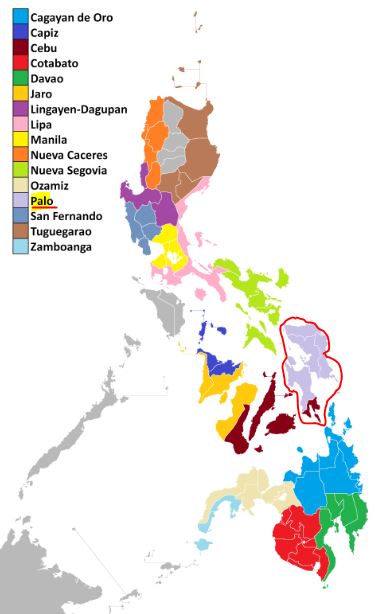
| The Ecclesiastical Province of Roman Catholic Archdiocese of Palo |
The Archdiocese of Palo has jurisdiction in the provinces of Eastern Visayas except Southern Leyte (which is under the Archdiocese of Cebu).
Historically, Limasawa island in Southern Leyte claims that “First Catholic Mass in the Philippines” happened here on Eastern Sunday of March 31, 1521. Hence, the island town of Limasawa is dubbed as the “birthplace of Roman Catholicism in the Philippines”.
If you ever visit Leyte and Samar
islands, don’t forget to visit some of our heritage churches located here:
1.
Santo Niño Parish

The flagship Catholic church of Tacloban City that houses the most
revered patron of Eastern Visayas: Holy Child Jesus or know as Santo Niño. The
structure was recently renovated as it was damaged by Typhoon Yolanda last
2013. People flock to this white church the time when I visited as the feast is
held every June 30.


2. Cathedral of Our Lord's Transfiguration Parish

Leyte’s metropolitan cathedral is the
seat of Archdiocese of Palo,
covering the Roman Catholic Churches within Eastern Visayas. It was also renovated
thanks to various donors who contributed in making the whole complex a
marvelous art. Notable is the twin towers seen at its façade. At the southern
wing, you can visit the mass grave of Yolanda victims turned into a memorial
garden. The overall building has as European gothic feel.


3.
Immaculate Concepcion Parish

This church by the bay has an old façade
made of coral stones but heavily renovated inside. You can see nearby capiz-windowed
houses located at poblacion of Baybay City, attesting the colonial
feel when the church was constructed in 1852.


4.
Nuestra Señora de la Asuncion Parish

The stone church of Hilongos has a newly-built façade but hidden at its west wing is
the old façade turned to transept. It was partly damaged during past war so you
can see ruins evident on its sides and the perimeter that looks like a wall of
a large fort.


5.
Saint Joseph Parish

The church of Matalom is located a few meters from the national highway. The
turquoise bell tower accentuates the old façade with a curved pediment. The
interior has walls with stones unpainted and pulpit in the eastern part
preserved.


6.
Our Lady of the Assumption Cathedral

One of the best preserved cathedrals in
Visayas, Maasin City is the seat of
the diocese administering the Catholic churches within Southern Leyte. It is a
suffragan of Archdiocese of Cebu. The old façade complements with the beautiful
painted ceilings with murals showing the Risen Christ and the Holy Eucharist.
The dome ceiling has a striking painting of eleven apostles’ symbols.


7.
Saint Bartholomew the Apostle Church

The main church of Samar province in Catbalogan City, which was established in 1616, was destroyed during the past
world war. Hence, an all-new structure was erected with circular glass window
and three altars.


8.
Saint Michael the Archangel Church

This town opposite of Tacloban City in
Leyte, has a church built on top of the hill. Basey in Samar has its stone structure still intact as well as the
interior where an old retablo stand under a mural on the ceiling with Saint
Michael the Archangel in the centerpiece and saints on the sides. The stunning
glass windows feature our beloved Filipino Saints Pedro Calungsod and Lorenzo
Ruiz.


Hoping when I get back to Eastern Visayas someday, I would be able to visit other churches within the metropolitan see. Have a blessed trip everyone!